

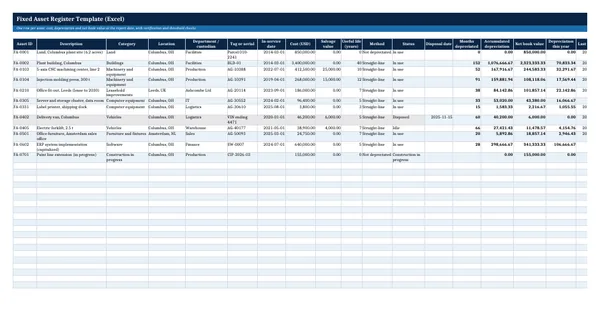
 Excel workbook preview
Fixed assets and capital expenditure
Fixed Asset Register Template (Excel)
3 free downloads per account. Just your email and a 6-digit code.
About this template
A fixed asset register is the listing of every capitalized asset an organization owns: what it is, where it is, what it cost and how much of that cost has been depreciated. Auditors, lenders and buyers ask for it at year end, during due diligence and whenever the balance sheet shows a large property, plant and equipment balance. The register is what proves that balance, so it has to agree with the general ledger and with the assets on the floor.
This Excel register holds one row per asset with cost, salvage value, useful life, status and the last date it was physically verified. Formulas compute months depreciated, accumulated depreciation, net book value and depreciation for the current year from a single report date, using straight-line depreciation with a full month in the month an asset is placed in service. A Summary sheet totals each category and reconciles to the ledger. Tax references point to IRS Publication 946, How To Depreciate Property.
Who it is for
The controller or accountant whose auditor or lender asked for a fixed asset listing that ties to the general ledger and found only a stale spreadsheet.
What is inside
- Asset Register sheet with 20 columns and 12 worked sample assets plus 20 blank formatted rows
- Live formulas for months depreciated, accumulated depreciation, net book value and depreciation this year, driven by one report date
- Verification check per asset (Current, Overdue, Never verified) against a cycle you set in months
- Capitalization threshold check that flags assets recorded below your threshold
- Dropdowns for 9 asset categories, depreciation method and 5 asset statuses
- Settings sheet with the report date, verification cycle, threshold and a category table with book lives and IRS Publication 946 tax references
- Summary sheet by category with cost, accumulated depreciation, net book value and depreciation this year, plus a general ledger reconciliation
- Freeze panes, filters, conditional formatting and landscape print fit
How to use it
Enter your report date and capitalization threshold on the Settings sheet, then replace the sample assets with your own.
Files
- XLSXfixed-asset-register-template.xlsx19 KB
Opens in Microsoft Word or Excel, Google Docs or Sheets, and LibreOffice. Based on general finance practice, not on one published standard. A template to adapt, not legal, tax or accounting advice.
Questions about this template
What should a fixed asset register include?
At minimum an asset number, description, category, location, custodian, tag or serial number, in-service date, cost, salvage value, useful life, depreciation method, accumulated depreciation, net book value, status and disposal date. Adding the last physical verification date lets you show the auditor when each asset was last seen. This template has all of these columns, with the depreciation figures calculated by formula.
How does the register calculate depreciation?
It uses the straight-line method: cost less salvage value, divided by the useful life in months, times the months in service up to the report date. An asset gets a full month of depreciation in the month it is placed in service and none in the month it is disposed of. Land and construction in progress are set to Not depreciated, so they carry no depreciation.
Is book depreciation the same as tax depreciation?
Usually not. Most US businesses depreciate for tax under MACRS, which uses the recovery periods, conventions and tables in IRS Publication 946, so the tax figures differ from straight-line book figures. This register is the book register. The Settings sheet lists the Publication 946 recovery periods for common categories as a reference for the separate tax depreciation schedule.
More Fixed assets and capital expenditure templates
Fixed assets and capital expenditure
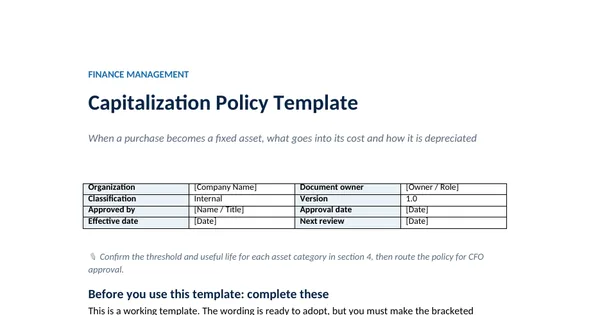
Capitalization Policy Template
Fixed assets and capital expenditure
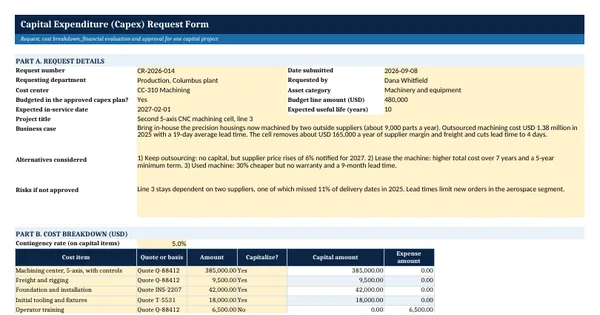
Capital Expenditure (Capex) Request Form
Fixed assets and capital expenditure
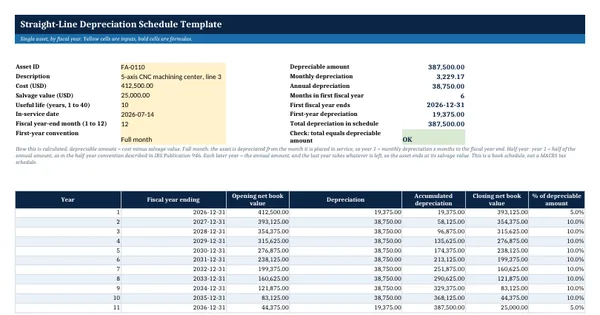
Straight-Line Depreciation Schedule Template
Fixed assets and capital expenditure