

 Word document preview
Order-to-cash and accounts receivable
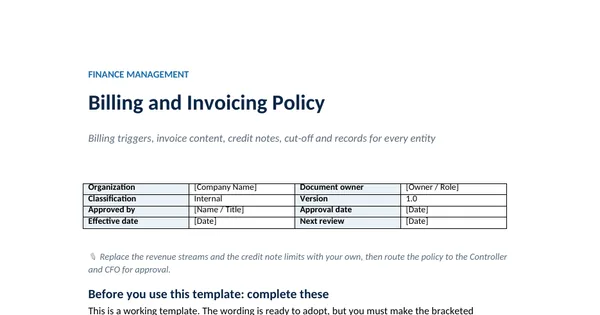
Billing and Invoicing Policy
3 free downloads per account. Just your email and a 6-digit code.
About this template
A billing and invoicing policy sets when an invoice is raised, what it must show, who may change billing data, how credit notes are approved and how billing is closed at month end. Without one, invoices go out late or wrong, credit notes become an unmonitored way to cut revenue and disputes slow down cash. Auditors look for it when they test revenue cut-off and credit notes after year end.
This template is an adoptable policy for an invented group with a US parent, a UK subsidiary and a Dutch sales office. It lists billing triggers per revenue stream, the content of a UK VAT invoice from HMRC VAT Notice 700, the EU reverse charge wording from Directive 2006/112/EC, a credit note authority table and retention periods taken from IRS and HMRC guidance.
Who it is for
The controller or billing manager who was asked by the auditor or a new CFO for the written rules on when and how invoices and credit notes are issued.
What is inside
- 17 numbered sections, including roles, compliance, exceptions and review
- Billing trigger and timing table for 6 revenue streams of a manufacturer with software subscriptions
- Invoice content table with the UK VAT invoice list from VAT Notice 700 and the EU reverse charge wording
- Credit note approval authority by amount and 7 reason codes
- Four month-end billing cut-off steps and four billing measures with example targets
- Records retention table built on IRS and HMRC guidance
- Pre-use checklist with [FILL IN] decisions and examples
How to use it
Replace the revenue streams and the credit note limits with your own, then route the policy to the Controller and CFO for approval.
Files
- DOCXbilling-and-invoicing-policy.docx41 KB
Opens in Microsoft Word or Excel, Google Docs or Sheets, and LibreOffice. Based on general finance practice, not on one published standard. A template to adapt, not legal, tax or accounting advice.
Questions about this template
What should a billing policy include?
When each type of revenue is billed, what every invoice must contain, how invoice numbers are controlled, who may change customer billing data, how credit notes and rebills are approved, how billing is closed at month end and how long records are kept. This template has a section for each, with a worked table for the revenue streams of a mid-size group.
What must a UK VAT invoice show?
HMRC VAT Notice 700 lists a unique sequential number, the time of supply and the date of issue if different, the supplier's name, address and VAT number, the customer's name and address, a description, and for each item the quantity, the VAT rate and the amount excluding VAT, with total VAT shown in sterling. Invoices are normally issued within 30 days of the tax point.
Who should approve credit notes?
Credit notes should be approved by someone outside the sales team who earns commission on the sale, with higher amounts going to the controller or CFO. Each credit note should refer to the original invoice and carry a reason code, so disputes and errors can be analyzed. This policy sets four approval levels by amount, from billing supervisor to CFO.
More Order-to-cash and accounts receivable templates
Order-to-cash and accounts receivable
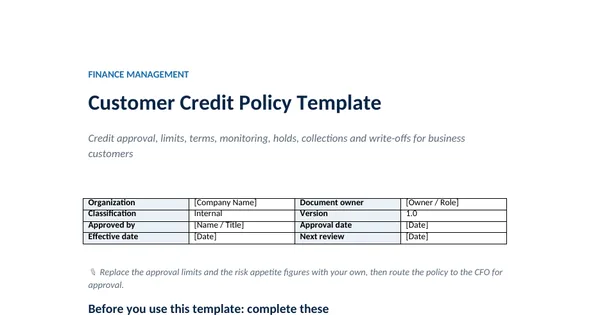
Customer Credit Policy Template
Order-to-cash and accounts receivable
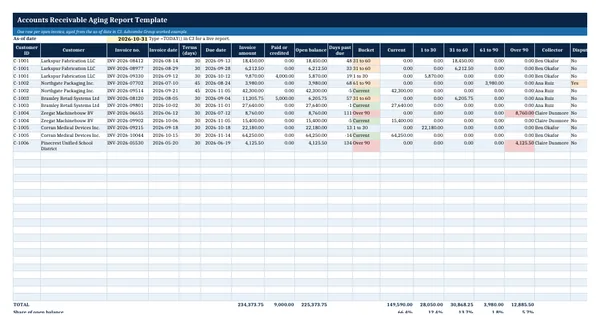
Accounts Receivable Aging Report Template
Order-to-cash and accounts receivable
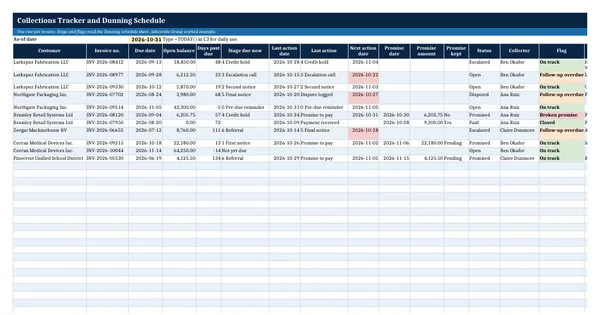
Collections Tracker and Dunning Schedule
Order-to-cash and accounts receivable