
 Word document preview
FinOps and cloud cost management
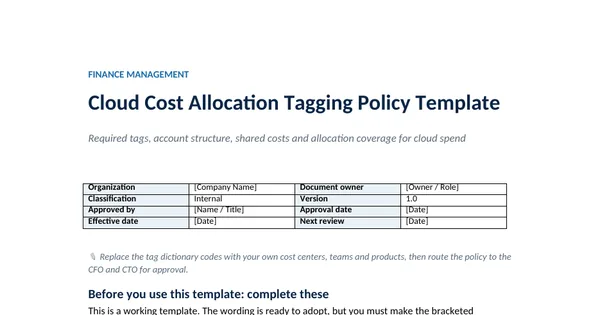
Cloud Cost Allocation Tagging Policy Template
3 free downloads per account. Just your email and a 6-digit code.
About this template
A cloud cost allocation tagging policy sets the tags every cloud resource must carry and the rules that turn a cloud bill into costs owned by teams, cost centers and products. It is needed when finance cannot say who spent what, when showback or chargeback starts, or when an auditor or the CFO asks how cloud costs reach the right budget. Without it, untagged spend piles up in a central pool that nobody owns.
This template holds a ready policy with a six-key tag dictionary, format and inheritance rules, an account structure, enforcement at provisioning, a worked unallocated cost review and four shared cost pools with their split methods. It is built on the Allocation capability of the FinOps Framework from the FinOps Foundation, published under CC BY 4.0, and uses the Tags, Billed Cost and Effective Cost definitions of the open FOCUS specification.
Who it is for
The controller or FinOps lead who was asked by the CFO why a third of the cloud bill has no owner and has no written tagging rules to point to.
What is inside
- 16 numbered sections, including Roles, Compliance and Enforcement, Exceptions and Review
- Mandatory tag dictionary with 6 keys, allowed values, examples and the source of truth for each
- Definitions of billed cost and effective cost in line with the FOCUS specification
- Account structure table from billing account down to resource
- Worked month-end unallocated cost review for Ashcombe Group
- Four shared cost pools with proportional, fixed and even split methods
- Four coverage measures with formulas, referencing the FinOps maturity indicators
- Roles table with 5 roles and a five-point checklist to adapt the policy
How to use it
Replace the tag dictionary codes with your own cost centers, teams and products, then route the policy to the CFO and CTO for approval.
Files
- DOCXcloud-cost-allocation-tagging-policy-template.docx42 KB
Opens in Microsoft Word or Excel, Google Docs or Sheets, and LibreOffice. Built on the FinOps Framework by the FinOps Foundation, published under the Creative Commons Attribution 4.0 licence (CC BY 4.0). Adapted and extended; not endorsed by the FinOps Foundation. A template to adapt, not legal, tax or accounting advice.
Questions about this template
What tags should a cloud tagging policy require?
Most policies require a small set that answers who owns the cost and why it exists: a cost center, an owner team, a product, an environment and an application identifier, plus an expiry date on temporary resources. Fewer mandatory keys enforced at creation work better than many optional keys that are never filled in.
How much of our cloud cost should be allocated?
The FinOps Framework maturity model gives sample indicators of at least 70% of cost allocated to a known owner at Crawl, at least 85% at Walk and more than 90% at Run. Set your own target from your measured baseline and raise it as enforcement improves.
How do we allocate costs that cannot be tagged?
Put resources in sub accounts that carry default tags, so untaggable charges inherit an owner from the account. Genuinely shared costs such as support plans or shared networks go into named pools that are split each month by a proportional, fixed or even method agreed with finance.