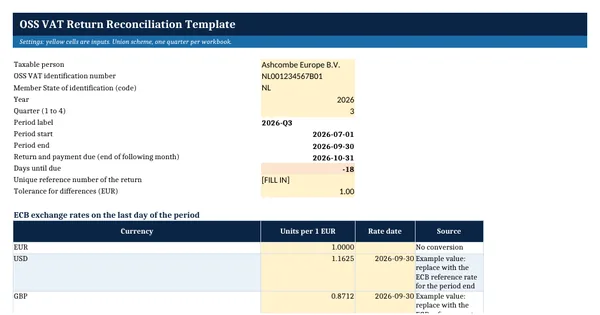
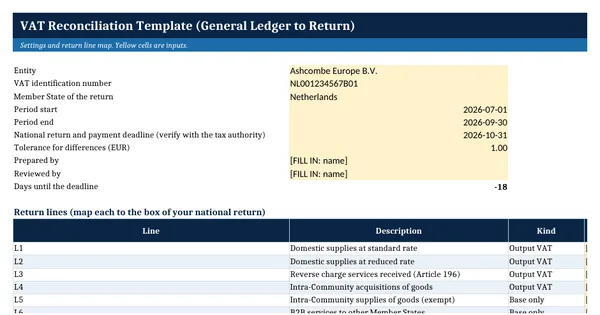
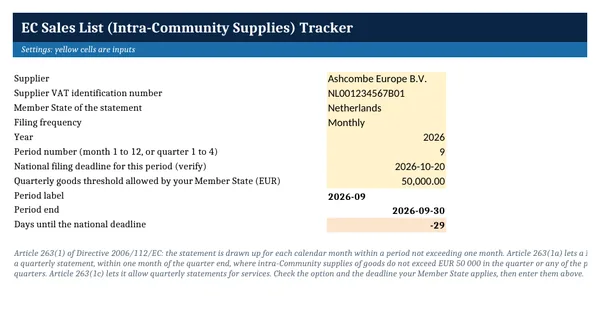
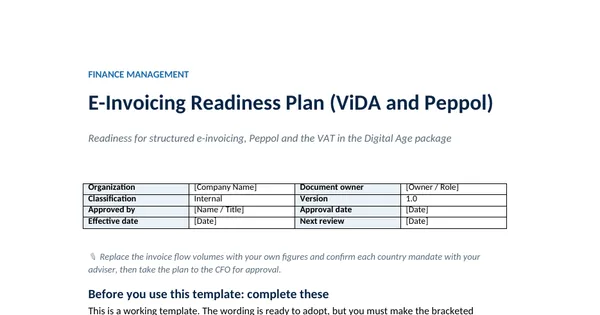
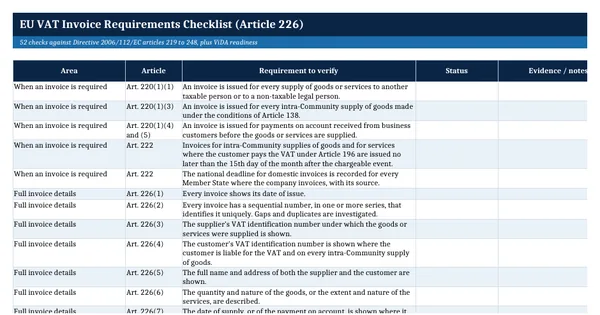
 Excel workbook preview
EU VAT Invoice Requirements Checklist (Article 226)
3 free downloads per account. Just your email and a 6-digit code.
About this template
A VAT invoice checklist tests whether the invoices a business issues carry every detail the EU VAT Directive requires. Article 226 of Council Directive 2006/112/EC lists the details of a full invoice, from the date of issue and sequential number to the VAT amount and mentions such as Reverse charge or Self-billing. Finance teams need this check when an auditor samples invoices, when a customer rejects one, or before input VAT recovery is challenged.
The workbook has 52 checks in nine groups: when an invoice is required, the Article 226 details, simplified invoices and credit notes, currency and language, self-billing, electronic invoices, storage, intra-Community supplies and ViDA readiness. A sample test sheet scores six real invoices against 20 details, and a timing sheet works out the Article 222 deadline. Every reference comes from the Directive text and the Commission's ViDA pages.
Who it is for
The accounts receivable lead or VAT manager who was told by the auditor or a tax inspector that invoices may be missing mandatory VAT details and needs to prove they are complete.
What is inside
- Invoice Checklist sheet with 52 checks in 9 groups, each tied to its article of Directive 2006/112/EC
- Status dropdown with colours and a live coverage percentage, plus a Summary sheet per group
- Invoice Sample Test sheet that tests 6 worked invoices against 20 invoice details, with present, missing and pass or fix results by formula
- Timing Check sheet with 10 worked invoices and 16 blank rows that works out the Article 222 deadline (15th day of the following month) and days late
- ViDA and Peppol readiness checks for structured e-invoices to EN 16931
- How to use sheet with the sampling method and the article references
How to use it
Pick six recent invoices of different types, test them on the Invoice Sample Test sheet, then work through the checklist and mark each line.
Files
- XLSXeu-vat-invoice-requirements-checklist.xlsx21 KB
Opens in Microsoft Word or Excel, Google Docs or Sheets, and LibreOffice. Built on free, official texts that anyone can read: laws, regulations, standards and guidance published by public bodies. A template to adapt, not legal, tax or accounting advice.
Questions about this template
What must be on a VAT invoice in the EU?
Article 226 of Directive 2006/112/EC lists the details: date of issue, a unique sequential number, the supplier's VAT number, the customer's VAT number for reverse charge and intra-Community supplies, both full names and addresses, the goods or services, the supply date, the taxable amount per rate, unit price, rate, VAT amount, and mentions such as Reverse charge or Self-billing where they apply.
When must an invoice for an intra-Community supply be issued?
Article 222 of the VAT Directive says that for supplies of goods under Article 138, and for services where the customer pays the VAT under Article 196, the invoice is issued no later than the fifteenth day of the month following the month in which the chargeable event occurs. Domestic deadlines are set by each Member State.
What is a simplified invoice?
Article 220a allows a simplified invoice where the amount is not higher than EUR 100, or for a document that amends an earlier invoice. Article 226b says it needs at least the date of issue, the supplier's identification, the type of goods or services, and the VAT amount or the information to calculate it. It is not allowed for intra-Community supplies of goods.