

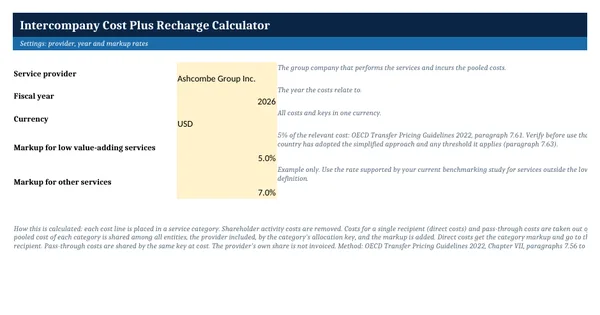
 Excel workbook preview
OECD transfer pricing and Pillar Two
Intercompany Cost Plus Recharge Calculator
3 free downloads per account. Just your email and a 6-digit code.
About this template
A cost plus recharge is how a group company that provides shared services, usually the parent, charges its costs plus a profit markup to the subsidiaries that benefit. Controllers need the calculation once a year for the intercompany invoices, and again when an auditor or a tax authority asks how each charge was built up.
This workbook follows the steps of the simplified approach for low value-adding intra-group services in Chapter VII, Section D of the OECD Transfer Pricing Guidelines: pool the costs per service category, remove shareholder activities and costs for a single recipient, allocate with a key that reflects benefit, and add the 5% markup to everything except pass-through costs. Other services use a benchmarked markup you enter yourself.
Who it is for
The controller or group accountant who has to work out the annual service charge from the parent to each subsidiary and show the auditor how it was calculated.
What is inside
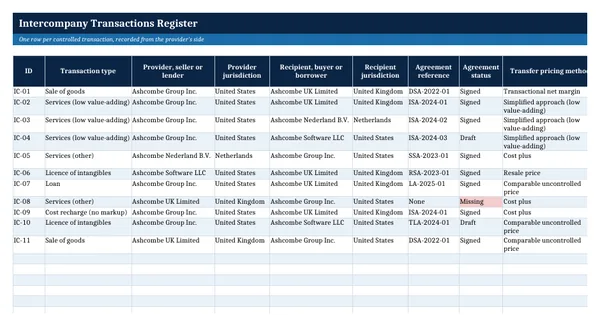
- Cost Pool sheet with 11 worked cost centre lines and 20 blank formatted rows
- Categories sheet with 8 service categories, each set to low value-adding, other benchmarked service or shareholder activity
- Keys sheet with headcount, IT users, revenue and transaction keys for 4 entities, shares by formula and a 100% check
- Allocation sheet that spreads pooled cost, markup and pass-through costs to each entity by formula
- Charges sheet with the amount to invoice per entity, leaving the provider's own share uncharged
- Markup rates as cited input cells: 5% for low value-adding services and a benchmarked rate for other services
- Checks that pooled costs are fully allocated and every allocation key adds to 100%
How to use it
Confirm the markup rates on the Settings sheet, enter your entities and their key data on the Keys sheet, then enter the cost centre costs on the Cost Pool sheet.
Files
- XLSXintercompany-cost-plus-recharge-calculator.xlsx24 KB
Opens in Microsoft Word or Excel, Google Docs or Sheets, and LibreOffice. Built on free, official texts that anyone can read: laws, regulations, standards and guidance published by public bodies. A template to adapt, not legal, tax or accounting advice.
Questions about this template
How is a cost plus markup calculated?
You take the cost of providing the service and add a profit percentage: charge equals cost times one plus the markup. In a group recharge, the cost is first pooled per service category and allocated to the recipients with a key such as headcount or revenue. Under the OECD simplified approach, pass-through costs are charged without a markup.
Is the 5% markup on low value-adding services mandatory?
No. Paragraph 7.61 of the OECD Guidelines sets 5% for groups that elect the simplified approach, and that rate does not need a benchmarking study. The approach is elective, and a tax administration may set a threshold above which it reviews the charges in full. Some countries have not adopted it, so check local rules first.
Which allocation key should be used?
Paragraph 7.59 of the OECD Guidelines says the key should reasonably reflect the benefit each recipient expects, for example headcount for people services, users for IT services and assets or transactions for accounting support. The same key should be used consistently for one category of services and from year to year unless there is a good reason to change.
More OECD transfer pricing and Pillar Two templates
OECD transfer pricing and Pillar Two
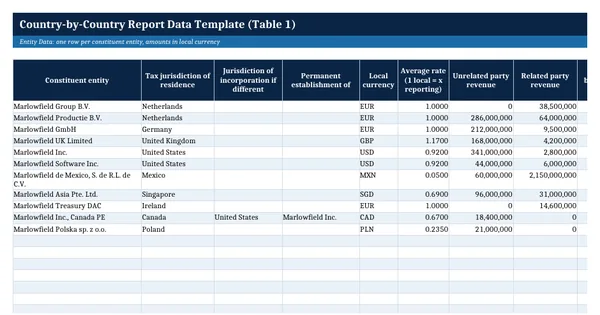
Country-by-Country Report Data Template (Table 1)
OECD transfer pricing and Pillar Two
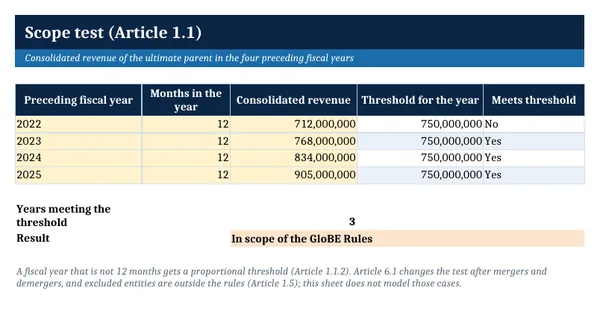
Pillar Two GloBE Effective Tax Rate Calculator (Simplified)
OECD transfer pricing and Pillar Two
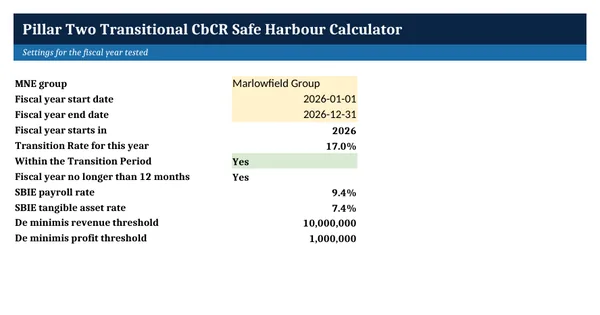
Pillar Two Transitional CbCR Safe Harbour Calculator
OECD transfer pricing and Pillar Two