 Excel workbook preview
OECD transfer pricing and Pillar Two
Pillar Two GloBE Effective Tax Rate Calculator (Simplified)
3 free downloads per account. Just your email and a 6-digit code.
About this template
Pillar Two is the OECD global minimum tax. Under the GloBE Model Rules, a group with consolidated revenue of EUR 750 million or more in at least two of the four preceding years works out an effective tax rate for each jurisdiction, and where it is below 15% a top-up tax applies to the excess profit. Boards and auditors now ask early where that exposure sits.
This workbook is a simplified, illustrative version of the jurisdictional calculation in Articles 5.1 to 5.5 and 9.2 of the OECD GloBE Model Rules. It takes GloBE income and adjusted covered taxes as inputs, and works out the ETR, the top-up tax percentage, the substance-based income exclusion, excess profit, the domestic top-up tax offset and the de minimis exclusion. It is not a full GloBE computation.
Who it is for
The group tax lead or CFO who needs a first, illustrative view of where the 15% global minimum tax could bite before the full GloBE calculation is done.
What is inside
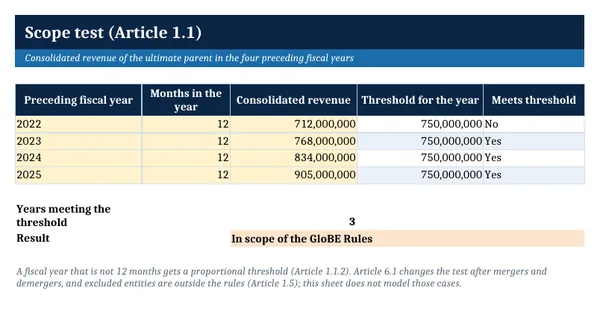
- Scope Test sheet applying the EUR 750 million revenue test to the four preceding fiscal years
- Inputs sheet with 8 worked jurisdictions and 16 blank formatted rows
- Calculation sheet with net GloBE income, ETR, top-up tax percentage, excess profit and jurisdictional top-up tax per jurisdiction
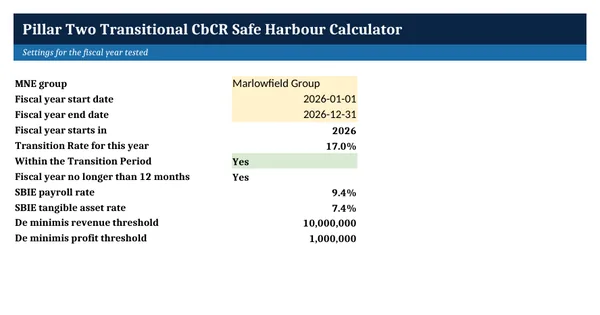
- Substance-based income exclusion with the Article 9.2 transition rates looked up by fiscal year
- De minimis test on three-year averages, applied only where the election is made
- Rates sheet with the 15% minimum rate, the transition rate tables and every threshold as a cited input
- Clearly labelled as simplified and illustrative, with the main GloBE adjustments it leaves out listed
How to use it
Run the Scope Test first, then enter GloBE income, adjusted covered taxes, payroll and tangible assets for each jurisdiction on the Inputs sheet.
Files
- XLSXpillar-two-globe-effective-tax-rate-calculator.xlsx21 KB
Opens in Microsoft Word or Excel, Google Docs or Sheets, and LibreOffice. Built on free, official texts that anyone can read: laws, regulations, standards and guidance published by public bodies. A template to adapt, not legal, tax or accounting advice.
Questions about this template
How is the Pillar Two effective tax rate calculated?
Article 5.1 of the GloBE Model Rules divides the sum of the adjusted covered taxes of the constituent entities in a jurisdiction by the jurisdiction's net GloBE income. If the result is below the 15% minimum rate, the top-up tax percentage is the difference, and it is applied to excess profit after the substance-based income exclusion.
What is the substance-based income exclusion?
It is a carve-out of a routine return on payroll and tangible assets. Article 5.3 sets it at 5% of eligible payroll costs plus 5% of the carrying value of eligible tangible assets, and Article 9.2 replaces those rates with higher transition rates, for example 9.4% and 7.4% for fiscal years beginning in 2026.
What is the Pillar Two de minimis exclusion?
Under Article 5.5 of the GloBE Model Rules, a group can elect to treat the top-up tax in a jurisdiction as zero if the average GloBE revenue there is below EUR 10 million and the average GloBE income is below EUR 1 million or a loss. The averages cover the current and the two preceding fiscal years.