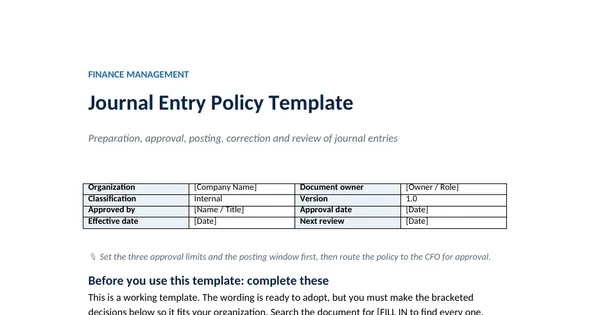
 Word document preview
Journal Entry Policy Template
3 free downloads per account. Just your email and a 6-digit code.
About this template
A journal entry policy sets the rules for every entry that changes the general ledger: who may prepare it, what evidence it needs, who approves it and when the period closes for posting. Auditors ask for it because manual entries are where errors and management override show up first. It is needed when a company grows past a single bookkeeper, adds a subsidiary, prepares for an audit, or finds an entry nobody can explain.
The template has fifteen numbered sections. Tables cover the seven entry types, the approval limits in six rows, record retention and the monthly journal review. Retention periods come from the IRS page on how long to keep records and section 388 of the UK Companies Act 2006. The correction rule points to 18 U.S.C. 1519. The worked example is Ashcombe Group, an invented manufacturer with a UK subsidiary.
Who it is for
The controller whose auditor asked for the written rules on who may prepare, approve and post a journal entry, and found only an email from three years ago.
What is inside
- 15 numbered sections, including roles and a policy close (compliance, exceptions, review)
- Entry type table: 7 types of journal entry with an example and the reversal rule for each
- Approval limits table in 6 rows, including top-side, post-lock and entries made by the controller or CFO
- Record retention table in 6 rows from IRS guidance and the UK Companies Act 2006, plus the company period
- Monthly journal review: 9 risk criteria and a 4-row monitoring report table
- Roles table for 7 roles, from preparer to audit committee
- Checklist of 7 decisions to make before adoption
How to use it
Set the three approval limits and the posting window first, then route the policy to the CFO for approval.
Files
- DOCXjournal-entry-policy-template.docx41 KB
Opens in Microsoft Word or Excel, Google Docs or Sheets, and LibreOffice. Based on general finance practice, not on one published standard. A template to adapt, not legal, tax or accounting advice.
Questions about this template
What should a journal entry policy include?
It should define the types of entry, the evidence each entry needs, approval limits by amount and type, a rule against self-approval, the posting window and period lock, how errors are corrected, how long records are kept, and a regular review of posted entries for unusual items. It also names who is responsible for each step, from preparer to approver.
Can the person who prepares a journal entry also approve it?
Under this template, no. The approver must be a different person with at least the authority set for the amount. Where the ERP cannot block self-approval, the monthly journal review lists every entry where the preparer and approver are the same user, and the controller follows up each one.
How long should journal entry support be kept?
It depends on the law that applies. The IRS says most tax records are kept 3 years, employment tax records at least 4 years and bad debt records 7 years. A UK private company keeps accounting records 3 years from when they are made, a public company 6 years. Many companies set a single longer period for all records.