
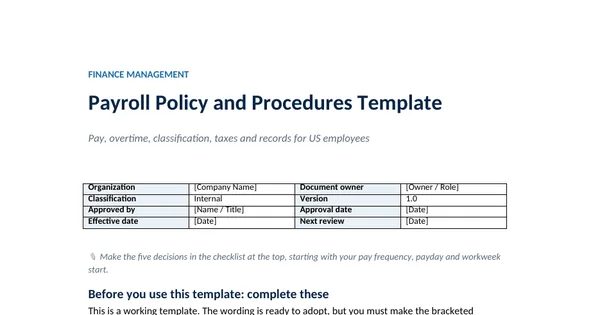
 Word document preview
Payroll Policy and Procedures Template
3 free downloads per account. Just your email and a 6-digit code.
About this template
A payroll policy sets the rules for how employees are paid and how payroll is run and controlled. Auditors ask for it when they test payroll, and it is often missing in growing companies where payroll grew up around one person and a provider. This template gives a US employer a complete policy covering pay, overtime, classification, taxes and records, ready to adapt and approve.
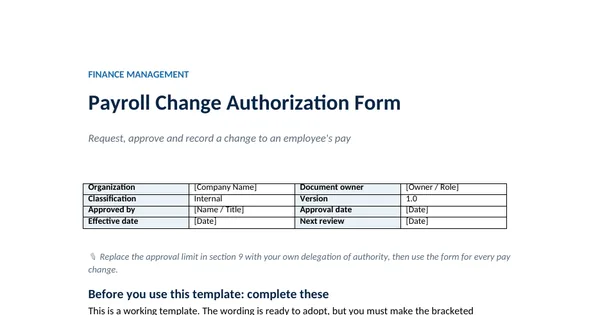
The overtime, regular rate, classification and recordkeeping rules come from the US Department of Labor Fact Sheets 17A, 17G, 21, 23, 56A and 56C. The withholding, deposit, return and retention rules come from IRS Publication 15. The policy also sets internal controls: approved change forms, segregation of duties, callback checks on bank changes, a preview register review and a quarterly Form 941 reconciliation.
Who it is for
The controller or HR lead who was told by the auditor or the new CFO that payroll has no written policy and procedures.
What is inside
- 8 policy sections, from paydays and the workweek to records, retention and access
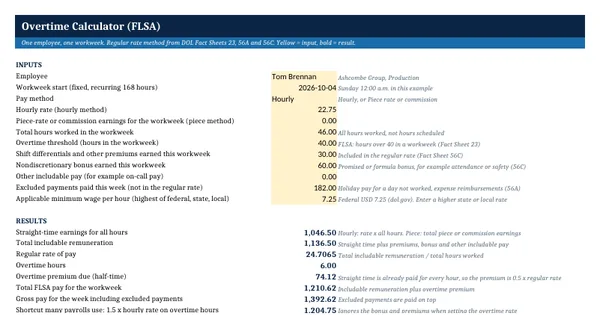
- Overtime and regular rate rules from DOL Fact Sheets 23, 56A and 56C, with a table of included and excluded payments
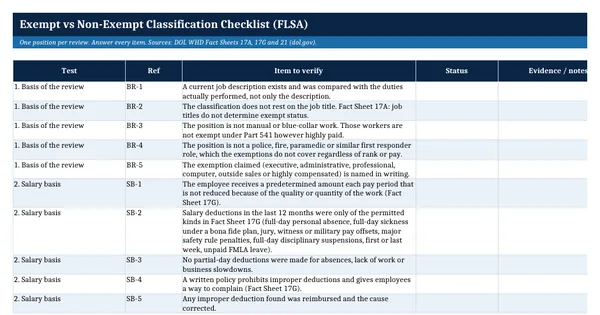
- Exempt classification tests and the permitted salary deductions from DOL Fact Sheets 17A and 17G
- Form W-4 rules from IRS Publication 15 for new hires, invalid forms and exemption renewals
- Payroll processing timetable with 6 steps, owners, timing and evidence
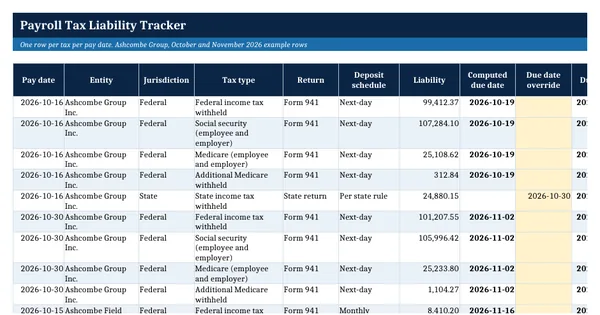
- Returns table for Forms 941, 940, W-2 and W-3, and a retention table from Fact Sheet 21 and Publication 15
- Roles table, compliance, exceptions and review sections
- Checklist of 5 decisions to make before adoption
How to use it
Make the five decisions in the checklist at the top, starting with your pay frequency, payday and workweek start.
Files
- DOCXpayroll-policy-and-procedures-template.docx41 KB
Opens in Microsoft Word or Excel, Google Docs or Sheets, and LibreOffice. Built on free, official texts that anyone can read: laws, regulations, standards and guidance published by public bodies. A template to adapt, not legal, tax or accounting advice.
Questions about this template
What should a payroll policy include?
It should define paydays and the workweek, how time is recorded and approved, how overtime and the regular rate are calculated, how positions are classified as exempt or non-exempt, how changes are authorized, how each payroll is reviewed, how taxes are deposited and filed, and how long records are kept. This template covers each of these.
Can hours be averaged over two weeks to avoid overtime?
No. DOL Fact Sheet 23 says the workweek is a fixed and regularly recurring period of 168 hours and that averaging hours over two or more workweeks is not permitted. Overtime is calculated for each workweek on its own, even when the pay period is biweekly or semimonthly.
How long must payroll records be kept?
DOL Fact Sheet 21 says payroll records are kept for at least three years and records used to compute wages, such as time cards, for at least two years. IRS Publication 15 says employment tax records are kept for at least four years. State law can require longer, so the policy uses the longest period that applies.