
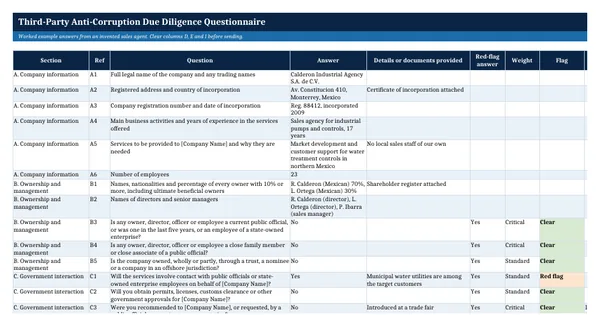
 Excel workbook preview
Anti-bribery (FCPA, UK Bribery Act)
Third-Party Anti-Corruption Due Diligence Questionnaire
3 free downloads per account. Just your email and a 6-digit code.
About this template
A third-party due diligence questionnaire collects the facts a company needs before it hires an agent, distributor, consultant or customs broker who may deal with customers or public officials on its behalf. Prosecutors and regulators look closely at third parties because they are a common channel for bribes. The DOJ Evaluation of Corporate Compliance Programs asks whether a company knows each third party's qualifications, associations and business rationale.
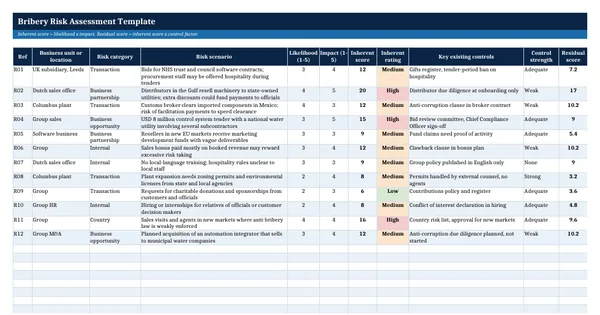
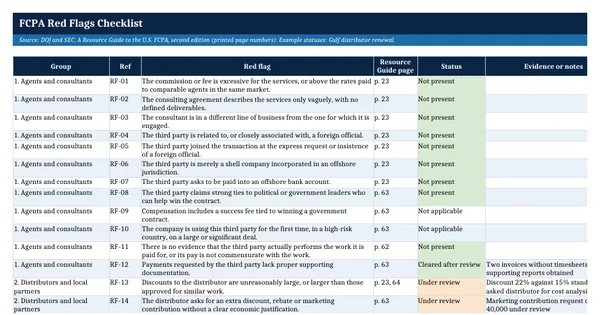
The workbook holds 36 questions in seven sections. Each yes or no question has its red-flag answer and weight, and a formula flags it when the third party answers. A Risk rating sheet combines five inherent risk factors with the flags to set a tier, shows the required actions and approver, and calculates the next review date. The questions follow the third-party red flags in the DOJ and SEC Resource Guide to the FCPA and the due diligence principle in the Ministry of Justice guidance.
Who it is for
The compliance or finance manager who must vet a new agent, distributor or consultant before the contract is signed and keep evidence of the review.
What is inside
- 36 questions in 7 sections, from ownership and government links to payments, compliance program and history
- Each yes or no question carries its red-flag answer and a Critical or Standard weight, and a formula flags the answer
- Worked example answers from an invented sales agent, ready to clear before sending
- Risk rating sheet: five inherent risk factors scored with formulas, plus the counts of red flags, critical flags and unanswered questions
- Risk tier formula (High, Medium, Low or Incomplete) with editable thresholds in yellow input cells
- Required actions and approver per tier, with the next review date calculated from the decision date
- Summary sheet with questions, answers, red flags and critical flags per section
- How to use sheet, dropdowns, filters, freeze panes and landscape print fit
How to use it
Clear the sample answers in the Questionnaire sheet, send it to the third party, then score the returned answers on the Risk rating sheet.
Files
- XLSXthird-party-anti-corruption-due-diligence-questionnaire.xlsx15 KB
Opens in Microsoft Word or Excel, Google Docs or Sheets, and LibreOffice. Built on free, official texts that anyone can read: laws, regulations, standards and guidance published by public bodies. A template to adapt, not legal, tax or accounting advice.
Questions about this template
Is a questionnaire enough for third-party due diligence?
No. The DOJ and SEC Resource Guide describes a case where a company relied on questionnaires and anti-corruption representations even though red flags had been found. A questionnaire is the starting point. Its answers should be checked against registries, references, background checks and media searches, and the depth of checking should rise with the risk tier.
Which answers count as critical red flags?
In this template a critical flag is an answer that by itself makes the third party high risk, such as an owner who is a public official, a request to be paid offshore or in cash, a refusal to accept audit rights, or a past bribery conviction. Any critical flag sets the tier to High, whatever the other scores, so the chief compliance officer must review it.
How often should third parties be re-checked?
The template calculates the next review from the decision date using months per tier, set by default to 12 months for High, 24 for Medium and 36 for Low. You can change these inputs. The Resource Guide also expects ongoing monitoring, such as updated due diligence, audit rights, training and annual compliance certifications.