

 Word document preview
OECD transfer pricing and Pillar Two
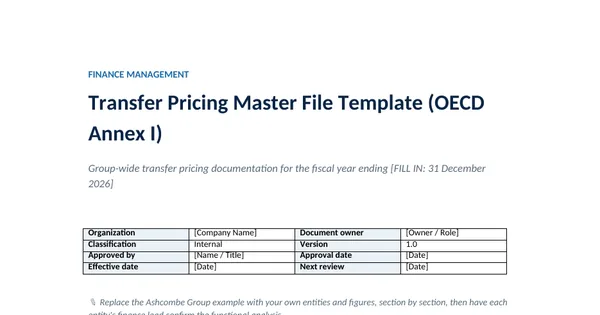
Transfer Pricing Master File Template (OECD Annex I)
3 free downloads per account. Just your email and a 6-digit code.
About this template
A transfer pricing master file is the group-wide part of the three-tier documentation set out in Chapter V of the OECD Transfer Pricing Guidelines. It gives every tax administration where the group operates the same overview: legal structure, business, intangibles, intercompany financing and financial and tax positions. Many countries require it from groups above a size threshold, and tax auditors often ask for it at the start of a transfer pricing review.
This template follows the content list in Annex I to Chapter V of the OECD Transfer Pricing Guidelines (2022 edition), heading by heading. It is fully worked for an invented US manufacturing and software group with a UK subsidiary and a Dutch sales office, with tables for entities, supply chain, functions and risks, services, intangibles, financing and rulings. Every item rests on the free OECD text on oecd.org.
Who it is for
The group tax lead or controller asked by a tax authority, the auditor or a new CFO for the group master file, who finds there is none or only an outdated one.
What is inside
- 11 numbered sections that follow the five Annex I headings, from organisational structure to financial and tax positions
- Legal entity table with ownership, main activities and headcount for an invented four-entity group
- Supply chain table for the five largest product and service lines by turnover, plus main markets
- Functional analysis table of key functions, important risks and important assets per entity
- Intra-group service arrangements table with the transfer pricing policy for each
- Intangibles register and intercompany financing table with pricing policies
- Financial and tax positions section covering the consolidated accounts, APAs and tax rulings, plus a 7-item checklist
How to use it
Replace the Ashcombe Group example with your own entities and figures, section by section, then have each entity's finance lead confirm the functional analysis.
Files
- DOCXtransfer-pricing-master-file-template.docx41 KB
Opens in Microsoft Word or Excel, Google Docs or Sheets, and LibreOffice. Built on free, official texts that anyone can read: laws, regulations, standards and guidance published by public bodies. A template to adapt, not legal, tax or accounting advice.
Questions about this template
What must a transfer pricing master file contain?
Annex I to Chapter V of the OECD Transfer Pricing Guidelines lists five areas: the organisational structure, a description of the business, the group's intangibles, its intercompany financial activities, and its financial and tax positions. Under those headings it asks for items such as the supply chain for the five largest products or services, a functional analysis, and a list of APAs and tax rulings.
What is the difference between the master file and the local file?
The master file gives a high-level, group-wide overview and is the same for every country. The local file covers the material controlled transactions of one local entity, with the amounts, the functional analysis, the transfer pricing method and the comparables. Chapter V of the OECD Guidelines describes both, with the Country-by-Country Report as the third tier.
How often should the master file be updated?
Chapter V of the OECD Guidelines recommends that the master file, the local file and the Country-by-Country Report be reviewed and updated annually, while recognising that business descriptions and functional analyses often change little from year to year. It suggests the master file be reviewed and, if needed, updated by the tax return due date of the ultimate parent.
More OECD transfer pricing and Pillar Two templates
OECD transfer pricing and Pillar Two
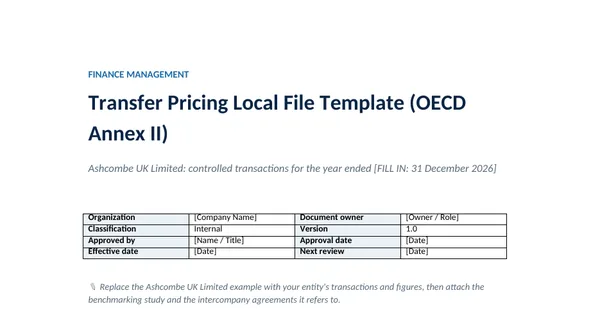
Transfer Pricing Local File Template (OECD Annex II)
OECD transfer pricing and Pillar Two
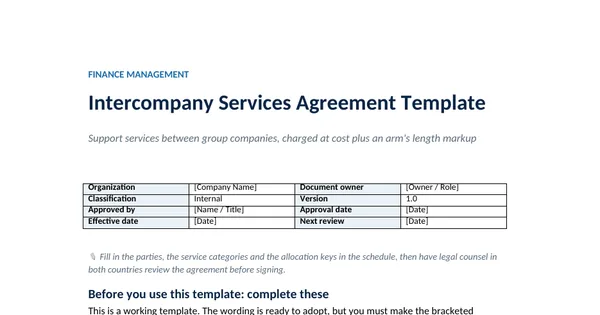
Intercompany Services Agreement Template
OECD transfer pricing and Pillar Two
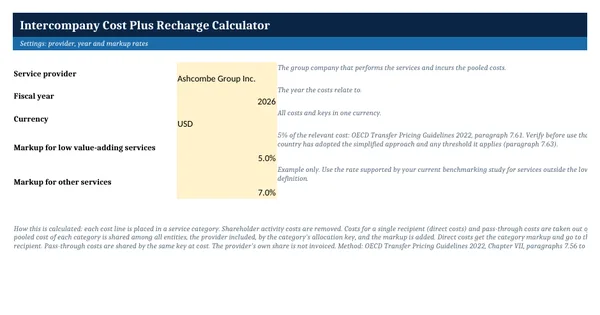
Intercompany Cost Plus Recharge Calculator
OECD transfer pricing and Pillar Two