
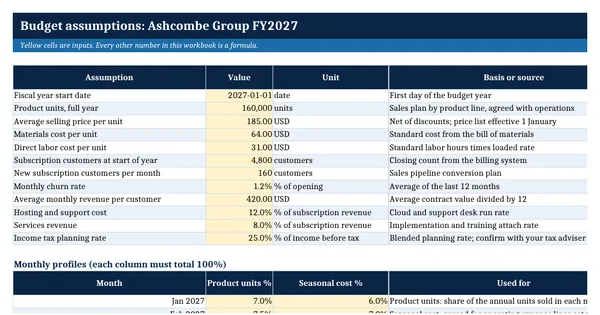
 Excel workbook preview
Budgeting, forecasting and FP&A
Annual Operating Budget Template (Excel)
3 free downloads per account. Just your email and a 6-digit code.
About this template
An annual operating budget is the financial plan for the coming fiscal year, month by month, that management and the board approve before the year starts. It sets the revenue the business expects, what it will spend to earn it, and the operating income that should result. Finance teams are usually asked for it in the autumn, when the CFO or the board wants a budget that can be explained line by line and tracked against actual results during the year.
This workbook builds the budget from drivers rather than typed monthly numbers. Product revenue comes from units, a seasonality profile and an average price. Subscription revenue comes from a customer roll-forward with new customers, a churn rate and revenue per customer. Operating expenses take one annual amount each and spread it evenly or seasonally. Every total, margin and quarterly figure is a live formula. It rests on general financial planning practice and cites no standard.
Who it is for
The controller or finance manager asked by the CFO or the board for next year's operating budget, who needs a clean monthly P&L budget built on drivers.
What is inside
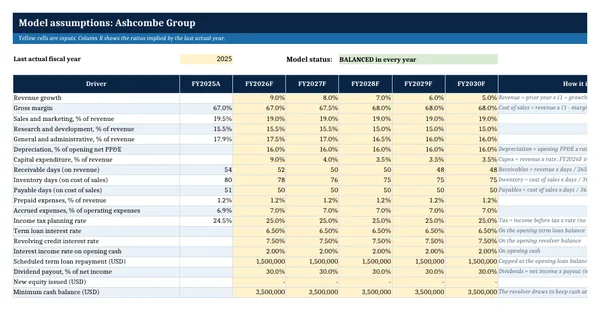
- Assumptions sheet with 12 driver inputs and two monthly profiles (product units and seasonal costs) with a live 100% check
- Revenue build sheet: product units times price, and a subscription customer roll-forward (opening, new, churned, closing, average)
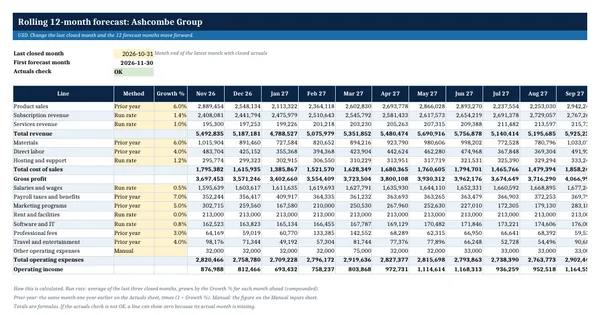
- Budget sheet with a 12-month P&L: 3 revenue lines, 3 cost of sales lines, 12 operating expense lines plus 3 spare lines, interest, tax and net income
- Each operating expense line takes one annual amount and a dropdown spread (Even or Seasonal) that sets every month by formula
- Gross margin, operating margin and EBITDA calculated for every month and the full year
- Summary sheet: Q1 to Q4 and full-year budget for every line next to the prior-year figures, with change in dollars and percent
- Worked example for an invented 350-person manufacturer with a software subscription business; yellow cells are the only inputs
- Print set to landscape, one page wide, with frozen labels on every sheet
How to use it
Replace the yellow driver inputs on the Assumptions sheet first, then the annual amounts and spread choices on the Budget sheet.
Files
- XLSXannual-operating-budget-template.xlsx20 KB
Opens in Microsoft Word or Excel, Google Docs or Sheets, and LibreOffice. Based on general finance practice, not on one published standard. A template to adapt, not legal, tax or accounting advice.
Questions about this template
What is the difference between an operating budget and a forecast?
An operating budget is set once before the year starts and approved as the target for the year. A forecast is updated during the year to show the latest expected outcome. Most finance teams keep the approved budget fixed and compare both the actual results and the latest forecast against it, so the variance to the original plan stays visible.
How do I spread an annual budget across 12 months?
Spread each line in the way its cost really falls. Salaries, rent and insurance usually fall evenly, so dividing by 12 is fair. Marketing, travel and professional fees follow the business calendar, so a seasonal profile that totals 100% is better. In this workbook each operating expense line has a dropdown that switches between the two methods.
Should the budget include depreciation and income tax?
Yes, if the board reviews net income. Depreciation belongs in operating expenses so that operating income is complete, and EBITDA can then be shown as a memo line. Income tax in a planning budget is usually a single planning rate applied to income before tax; confirm the rate with your tax adviser before the budget is approved.