
 Excel workbook preview
Budgeting, forecasting and FP&A
Three-Statement Financial Model Template
3 free downloads per account. Just your email and a 6-digit code.
About this template
A three statement model links the income statement, the balance sheet and the cash flow statement so that a change in one assumption flows through all three. Banks ask for one when a business applies for a loan or a covenant reset, investors ask for one in a funding round, and boards use one to test whether a plan can be financed. The proof that it is built correctly is that the balance sheet balances in every projected year.
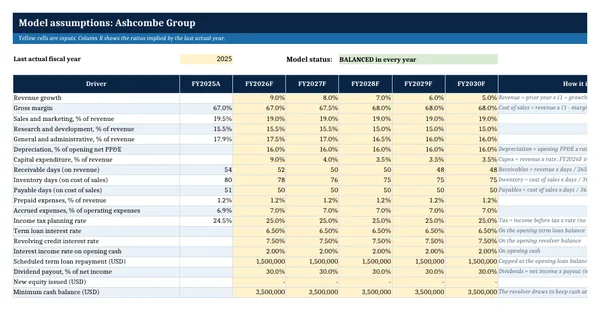
This workbook starts from one historical year and projects five. Revenue growth and margin ratios drive the income statement. Working capital days, a fixed asset roll-forward and a debt schedule drive the balance sheet. An indirect cash flow statement produces closing cash, and a revolving credit line draws or repays to hold a minimum cash balance. Interest uses opening balances, so there is no circular reference. It rests on general financial modelling practice.
Who it is for
The finance manager or CFO asked by a lender, an investor or the board for a projected income statement, balance sheet and cash flow that tie together.
What is inside
- One historical year plus 5 projection years, with the base year set from one input
- Assumptions sheet with 20 drivers per year, and the historical ratios calculated from the base year for calibration
- Income statement from revenue growth, gross margin and three operating expense ratios down to net income
- Balance sheet built from receivable, inventory and payable days, PP&E roll-forward, debt and equity
- Indirect cash flow statement whose closing cash feeds the balance sheet, with a revolving credit line that draws to hold a minimum cash balance
- Live balance check for every year plus one model status cell, colored green when the model balances and red when it does not
- No circular references: interest is calculated on opening balances
- Ratios sheet with 13 measures, including net debt to EBITDA, interest cover, return on equity and free cash flow conversion
How to use it
Enter your last actual year on the Income Statement and Balance Sheet sheets, confirm the balance check shows Balanced, then set the assumptions.
Files
- XLSXthree-statement-financial-model-template.xlsx18 KB
Opens in Microsoft Word or Excel, Google Docs or Sheets, and LibreOffice. Based on general finance practice, not on one published standard. A template to adapt, not legal, tax or accounting advice.
Questions about this template
How do the three financial statements link together?
Net income from the income statement starts the cash flow statement and is added to retained earnings on the balance sheet. Depreciation is added back in operating cash flow and reduces fixed assets. Changes in working capital balances become cash flow lines. The cash flow statement then produces closing cash, which is the cash line on the balance sheet.
Why does my balance sheet not balance?
Usually because one balance sheet movement has no matching cash flow line, or the sign is reversed. Check that every balance sheet line except cash and retained earnings has a cash flow entry equal to its change, that net income and dividends both reach retained earnings, and that the historical year balances before you project anything.
What is a revolver in a financial model?
A revolver is a revolving credit facility that the model draws on automatically when cash would fall below a minimum balance, and repays when there is surplus cash. It keeps projected cash from going negative and shows how much short-term borrowing the plan needs. Here interest on it uses the opening balance so the model avoids a circular calculation.