

 Word document preview
FinOps and cloud cost management
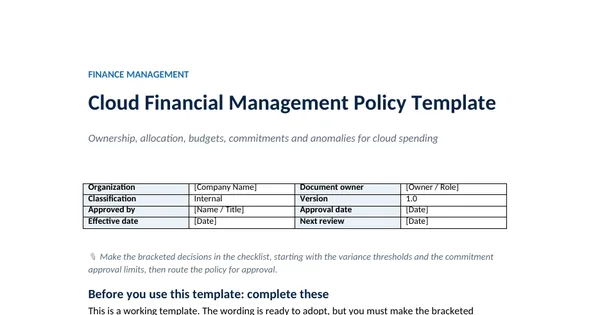
Cloud Financial Management Policy Template
3 free downloads per account. Just your email and a 6-digit code.
About this template
A cloud financial management policy sets the written rules for how an organization plans, buys, uses, allocates and reports its spending on public cloud services. It is needed when cloud spend has grown into a material cost line, when the auditor asks how commitment purchases are approved, or when a new CFO finds that nobody owns half of the cloud bill. A clear policy gives every account an owner and every large decision an approver.
This template rests on the six principles and the Inform, Optimize and Operate phases of the FinOps Framework, used under CC BY 4.0, and on the open FOCUS specification for cost data. It covers ownership, mandatory tags, budget and forecast variance triggers, commitment discount approvals with a breakeven test, anomaly response, usage optimization, invoice reconciliation and chargeback, and the KPIs reported each month.
Who it is for
The CFO, controller or FinOps lead asked by the auditor, the board or a new CFO for the written rules behind the company's cloud spending.
What is inside
- 10 body sections plus roles, compliance, exceptions and review
- 6 worked tables: account ownership, mandatory tags, budget variance triggers, commitment approval limits, anomaly severity and KPIs
- Built on the six FinOps principles and the Inform, Optimize and Operate phases, with the CC BY 4.0 attribution
- Allocation on amortized Effective Cost as defined in the FOCUS specification
- Commitment purchase rules: central buying, approval by value, breakeven test and laddered expiry dates
- Anomaly response with three severity levels, acknowledgement times and escalation
- Month end rules for invoice reconciliation, accruals, prepaid commitments and chargeback
- Roles table for 7 roles and a checklist of the decisions to make before approval
How to use it
Make the bracketed decisions in the checklist, starting with the variance thresholds and the commitment approval limits, then route the policy for approval.
Files
- DOCXcloud-financial-management-policy-template.docx42 KB
Opens in Microsoft Word or Excel, Google Docs or Sheets, and LibreOffice. Built on the FinOps Framework by the FinOps Foundation, published under the Creative Commons Attribution 4.0 licence (CC BY 4.0). Adapted and extended; not endorsed by the FinOps Foundation. A template to adapt, not legal, tax or accounting advice.
Questions about this template
What should a cloud cost management policy include?
At minimum: who owns each cloud account, which tags every resource must carry, how budgets and forecasts are set and what happens when spend runs over, who may buy commitment discounts and up to what value, how cost anomalies are handled, and how cloud cost reaches the ledger through showback or chargeback. This template covers each of these with a table.
Who should approve cloud commitment purchases?
Commitments lock in spend for one or three years, so they follow the delegation of authority like any other contract. The template routes them through the FinOps lead, adds the CFO above a value threshold and the CEO or board above a higher one. Set the thresholds to match your own delegation of authority.
Is FinOps the same as cloud cost cutting?
No. The FinOps Foundation defines FinOps as an operational framework and cultural practice that maximizes the business value of technology, with principles such as business value driving technology decisions. Some actions do reduce cost, but the policy also covers forecasting, ownership, unit economics and reporting so that spending decisions are made with the cost in view.
More FinOps and cloud cost management templates
FinOps and cloud cost management
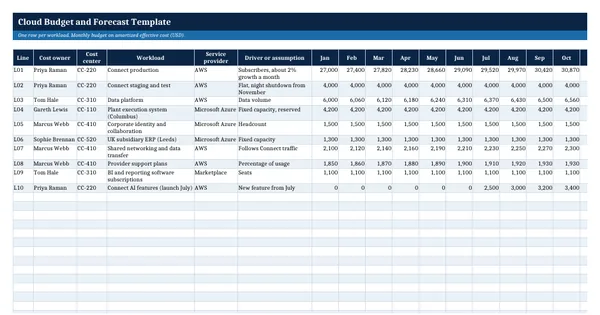
Cloud Budget and Forecast Template
FinOps and cloud cost management
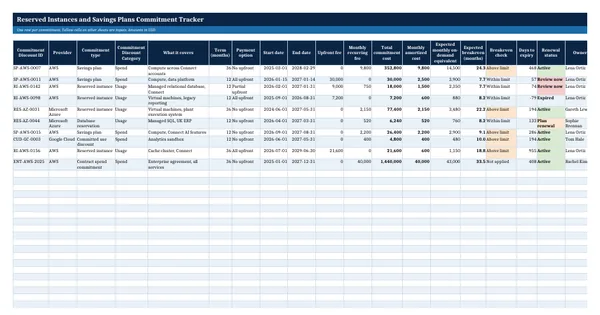
Reserved Instances and Savings Plans Commitment Tracker
FinOps and cloud cost management
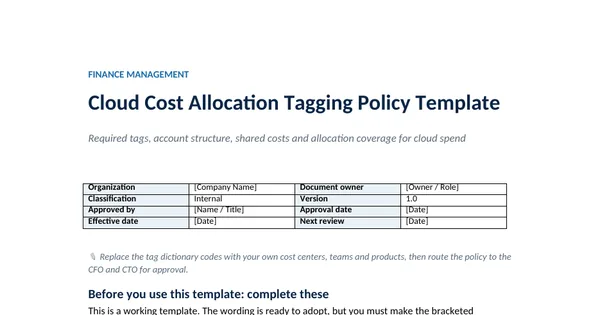
Cloud Cost Allocation Tagging Policy Template
FinOps and cloud cost management